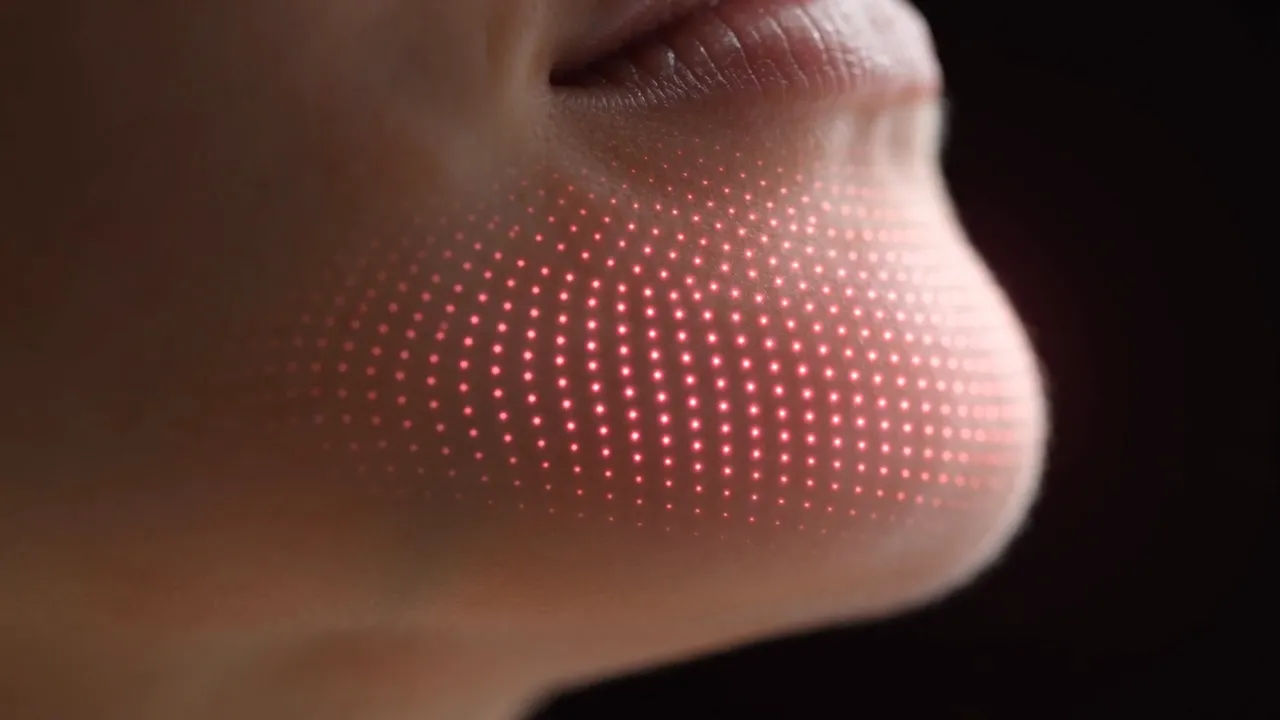
What is a CO2 laser?
A CO2 laser emits light at 10,600 nm, which water in the skin absorbs strongly. Where it lands, it vaporises tissue and leaves a rim of heat around the spot, which prompts a collagen response as the skin heals. It is a resurfacing laser, not a pigment laser.
Fractional treatment places that energy in microscopic columns and leaves untouched skin between them. The idea was introduced in a 2004 study that used a non-ablative prototype at about 1.5 µm [1]. Fractional CO2 uses the same pattern, but each column is vaporised rather than only heated, and healing starts from the bridges of intact skin.
Fractional or fully ablative CO2: what is the difference?
Fractional describes how the energy is delivered, in columns, not which laser it is. The CO2 work described on this site is fractional.
| Approach | What it does | Recovery and risk |
|---|---|---|
| Fully ablative CO2 | Removes the whole surface layer over the treated area | A larger wound, a longer recovery and more pigment risk |
| Fractional CO2 | Vaporises a grid of columns and leaves the skin between them intact | Heals from the intact bridges, with depth and density set separately |
| Non-ablative fractional | Heats columns beneath an intact surface | A shorter recovery, with a gentler effect on deep, sharp scar edges |
What is CO2 laser used for?
Here it is used mainly for scars and texture, and as a precise tool for some raised benign lesions. It is not a pigment treatment, and it is a poor way to deal with a discrete sun spot.
| Concern | How CO2 is used | Read more |
|---|---|---|
| Boxcar scars | Point shots into the pits, then fractional passes, for deeper scars with defined walls | Boxcar scars |
| Ice-pick scars | Fractional passes over the surrounding skin, with TCA CROSS placed into each pit | Ice pick scars |
| Rolling scars | Considered once subcision has released the tether | Rolling scars |
| Other scars | Surgical, injury and chickenpox scars and stretch marks are assessed one by one | Stretch marks |
| Raised benign lesions | One option for skin tags, warts, seborrhoeic keratoses or benign moles, after examination | Mole removal |
| Pigment and melasma | Not used: it does not treat pigment without a wound, and heat can provoke melasma | Pigmentation removal |
Is CO2 laser suitable for Asian skin?
Yes, with planning built around one risk: post-inflammatory darkening. Fitzpatrick III to V skin is not excluded, but its pigment cells respond briskly to the controlled wound. Darkening usually appears weeks after the surface has healed, most often on the cheeks and wherever the sun reaches.
A study measured this in 13 adults with skin type IV given three fractional CO2 sessions for acne scars. Mild darkening followed in 92% of them and after 51% of sessions, and it resolved in about five weeks on average [2]. The sample was small, the study used a different CO2 device from the one used here, and its abstract describes no control group. A larger series of 490 deep fractional CO2 treatments recorded darkening after 1.2% of them, but it covered skin types I to IV only, so it is likely to understate the risk in darker skin [3].
That is why density is kept conservative, sun exposure is controlled around treatment, and review is timed to when darkening would show. CO2 laser and Asian skin covers this in depth.
Who is CO2 laser suitable for, and who should wait?
Suitability is decided at examination. These are the usual groupings.
| Group | What it covers | What happens |
|---|---|---|
| Tends to suit | Settled boxcar, ice-pick or mixed scars and coarse texture, with time to heal and stay out of the sun | Scars are mapped, then depth and density are set per scar |
| Should wait | Pregnancy, active acne, infection or a cold sore in the area, a fresh tan, recent isotretinoin, photosensitising medicine | Treatment is deferred, not squeezed in |
| Needs extra caution | A keloid tendency, poorly controlled diabetes, immunosuppression, smoking, past radiotherapy to the area, active vitiligo | Settings, spacing or the tool may change |
| Active melasma | Heat and ablation can provoke it | Melasma is managed first, or another tool is chosen |
| Better served elsewhere | Tethered scars alone, discrete pigment | Subcision or pico laser is assessed instead |
Depth, density and passes: what does each setting control?
No usual figures are given, because the right settings depend on scar type, skin type, site and past reactions. Dr Sin Yong sets them for each patient. This is what each one controls.
| Setting | What it controls | How it is used here |
|---|---|---|
| Energy per column | How deep each column goes and how much tissue it removes | Depth is kept to where a scar needs it |
| Density | How much of the skin the columns cover in one pass | Kept conservative in darker skin, because coverage adds to inflammation |
| Pulse shape | How each pulse rises, dwells and tails off | Set to limit heat spreading into nearby skin |
| Point shots and passes | Depth into single pits versus coverage of the skin around them | Pits first, then fractional passes |
| Field per visit | How much injury the skin carries at once | A smaller field or fewer passes where pigment risk is higher |
| Interval | Time for healing, and for any darkening to show | Set at review, not by the calendar |
How Dr Sin Yong uses CO2 laser: the S3 Resurfacing Lift
S3 stands for Stack, Scan and Sculpt. It is Dr Sin Yong's acne scar protocol on the DEKA SmartXide Tetra Pro, and he performs it himself.
Each scar is mapped with the skin stretched under directed light, so tethered, ice-pick and boxcar scars are told apart. Pigment is examined with a dermatoscope where needed.
The depth and heat of each pulse are set to reach the base of a deep scar while sparing the tissue beside it.
Pattern, density and spacing are balanced against healing time and pigment risk in Asian skin.
Spot geometry is used on scar edges and surface contour. Tethered scars are released separately, by subcision.
Subcision and TCA CROSS come where the scar map calls for them. Where scars and pigment share a face, pico laser is staged apart, not stacked on one area in one visit.
A fresh tan, active acne, infection or recent isotretinoin means waiting. CO2 is not used for a sun spot or for melasma.
“Resurfacing parameters do not transfer between skin types. A setting validated on lighter skin is a starting point in Asia, not an answer.”
Pico, erbium and CO2: which job does each do?
These tools act on different targets at different depths, so one does not replace another, and a face may need more than one in a planned order. In a 2023 split-face pilot of 31 Asian patients with atrophic scars, scar scores fell 39.11% with fractional picosecond laser and 43.73% with ablative erbium, with pigmentation on 1 versus 8 sides [4]. It did not test CO2, and it used a different pico laser and an ablative erbium laser, not the FSX Laser used here. The table compares mechanism and job, not rank.
| Tool | How it acts | Main job here |
|---|---|---|
| Pico laser | Very short pulses break up pigment, mainly through pressure | Sun spots, freckles and tone |
| Non-ablative erbium and thulium (FSX Laser) | 1540 nm and 1927 nm heat columns beneath an intact surface | Fine lines, pores and superficial scars |
| Fractional CO2 (S3 Resurfacing Lift) | 10,600 nm vaporises columns, with heat around each | Deeper boxcar and ice-pick scars, coarse texture |
| RF microneedling | Needles deliver radiofrequency heat beneath the surface | Rolling and shallow boxcar scars, pores and texture |
Does fractional CO2 laser work? What studies measured
Studies report change in scar scores, but they differ in device, skin type and method, and none predicts your result. Results vary.
| Study | What it measured | Limits |
|---|---|---|
| 2025 systematic review, seven studies [5] | Fractional laser for acne scars: most patients showed roughly 30% to 70% improvement. Redness, swelling and darkening were the commonest side effects | Seven studies only; not specific to this device |
| 2010 study, 13 adults with skin type IV [2] | Three fractional CO2 sessions for acne scars. At six months, 85% were graded 25% to 50% improved or more. Mild darkening followed in 92% | Small; a different CO2 device; the abstract describes no control group |
| 2011 series, 490 deep fractional CO2 treatments [3] | Side effects after 13.6% of treatments: acne-like spots 5.3%, cold sores 2.2%, bacterial infection 1.8%, yeast infection 1.2%, darkening 1.2%. No scarring was reported | Retrospective, one practice, skin types I to IV only |
What happens on the day, and how does the skin heal?
The first visit is a consultation, and the laser is a separate visit. Healing is described in stages rather than dates, because depth, density, area and skin all change it. CO2 laser downtime and CO2 laser aftercare give the detail.
What are the risks of CO2 laser?
The risk that matters most in Asian skin is post-inflammatory darkening. Infection, cold sores, acne-like spots, prolonged redness and, uncommonly, scarring can also occur. Fever, spreading redness, pus, or a red hot lump: a doctor the same day, or A&E if none can see you. Trouble breathing or swallowing, or swelling of the tongue or throat: call 995. Change in vision or eye pain after treatment near the eye: call 995.
| Risk | What it looks like | How the risk is lowered |
|---|---|---|
| Post-inflammatory darkening | Brown patches weeks after healing, often on the cheeks | Conservative density, sun control and review timed to when it shows |
| Infection | Thick, yellow or honey-coloured crusts, or oozing that increases | Clean, moist healing and no picking; call the clinic the same day if you see these signs |
| Cold sore flare | A cluster of small, painful blisters | Antiviral cover where you have had cold sores; call the clinic the same day if blisters appear |
| Acne-like spots | Small spots while the skin heals | Bland products and review |
| Prolonged redness | Pinkness that lasts longer than expected | Sun protection and review |
| Scarring | A firm, raised or thickened area | Depth and density kept to what each scar needs, and caution with a keloid tendency |
Why is CO2 laser planned one session at a time?
Because each session is a planned wound, the next step is decided only after the skin has healed and any darkening has had time to show. No session count or interval is set in advance. Depth follows scar type, and the plan follows your skin's response. A review can lead to another resurfacing pass, a release step the laser cannot do, such as subcision, or nothing further. Ablative treatment is a larger step with a longer pause after it, so it is not quoted as a fixed course.
How much does CO2 laser cost in Singapore?
The fee is given after assessment, because it follows a scar map and a plan that do not exist until your skin has been examined. No figure is published, and a figure for one session would not describe your plan. You receive a written, itemised quote, and further steps are confirmed at review.
| What affects the fee | Why |
|---|---|
| Scar types and severity | Boxcar, ice-pick and rolling scars need different steps |
| Area and zones | A few scars differ from a whole face |
| Depth and density | Set per scar and per skin type |
| Other steps | Whether subcision or TCA CROSS forms part of the plan |
| Staging and review | Each further session is decided at review, not sold in advance |